Showing posts with label illiterate. Show all posts

Saturday, February 13, 2010

Tom’s School Reading and Reading for Enjoyment

Throughout high school, Tom was assigned books to read. Often he would have preferred to read an assigned book within a few days; however the teachers parceled out pages and then quizzed on those pages. Completing the book ahead of schedule would have meant poor performance on the frequent quizzes, which often asked questions like what was a character wearing or eating (as if that had much relevance to the overall story).

Most of the assigned reading was melancholy. The themes usually centered on death and misery instead of life and joy. Tom recalls reading the following books in high school:

  • Ethan Frome (about attempted collaborative suicide);
  • A Separate Peace (about high school friends and one becoming jealous to the point of trying to kill his friend);
  • The Great Gatsby (about a rich man who pines for a shallow woman which ends up causing him to be murdered);
  • Jane Eyre (about an unattractive British woman who is to marry her older boss until she learns he is already married to a nut);
  • The Wide Sargasso Sea (about the life of the nut in Jane Eyre before she marries the rich British dude);
  • To Kill a Mockingbird (about racism which kills an innocent black man);
  • The Red Badge of Courage (about death and dying during the Civil War)
  • The Good Earth (about a newer Chinese generation taking over and placing the preceding generation in a corner with opium).

Tom needed other books to read in order to keep him reading. The school books alone would have destroyed all desire to read in the teenager. So, Tom sought out adventure stories including books by Edgar Rice Burroughs (Tarzan, John Carter of Mars, et al), Sir Arthur Conan Doyle (The Lost World, Sherlock Holmes), Jack London (White Fang, Call of the Wild, Sea Wolf), and other early Twentieth Century novelists. These books also dealt with themes like death, but in a way that was positive, life reaffirming, and adventurous. Like many other teenagers, he also enjoyed comic books. These books gave Tom a desire to discover, learn, travel, and be something, whereas the assigned school books caused him to wonder what the purpose of life was and whether life is worth living when there can be so much tragedy and horror.

As an adult, Thomas still does not know why the school district assigned the reading it did when thousands of other books with more engaging themes could have been on the reading list. He figures that the books would not survive as literature if not foisted upon young minds whose world views would thereafter be affected. He wonders if the reason so few adults read books after graduation has anything to do with the reading that had been required.

Teen-aged years were traumatic enough. After all, teenagers deal with wanting to be free while restricted by parents, school, and other authority. Teenagers deal with new emotions that are stronger than at any other time in life. Why then should the school force such sad literature upon teenagers already dealing with turbulent, troubling times?

Sunday, February 7, 2010

Tommy Learns to Read

In 1986, Tommy's third grade teacher believed that Tommy might have an eye problem and told his parents to have his vision checked. Tommy was not doing well in the reading portion of the class. He knew the alphabet, but did not sound out words on the page. He seemed to not even notice the words. However, they soon learned that Tommy had perfect vision.

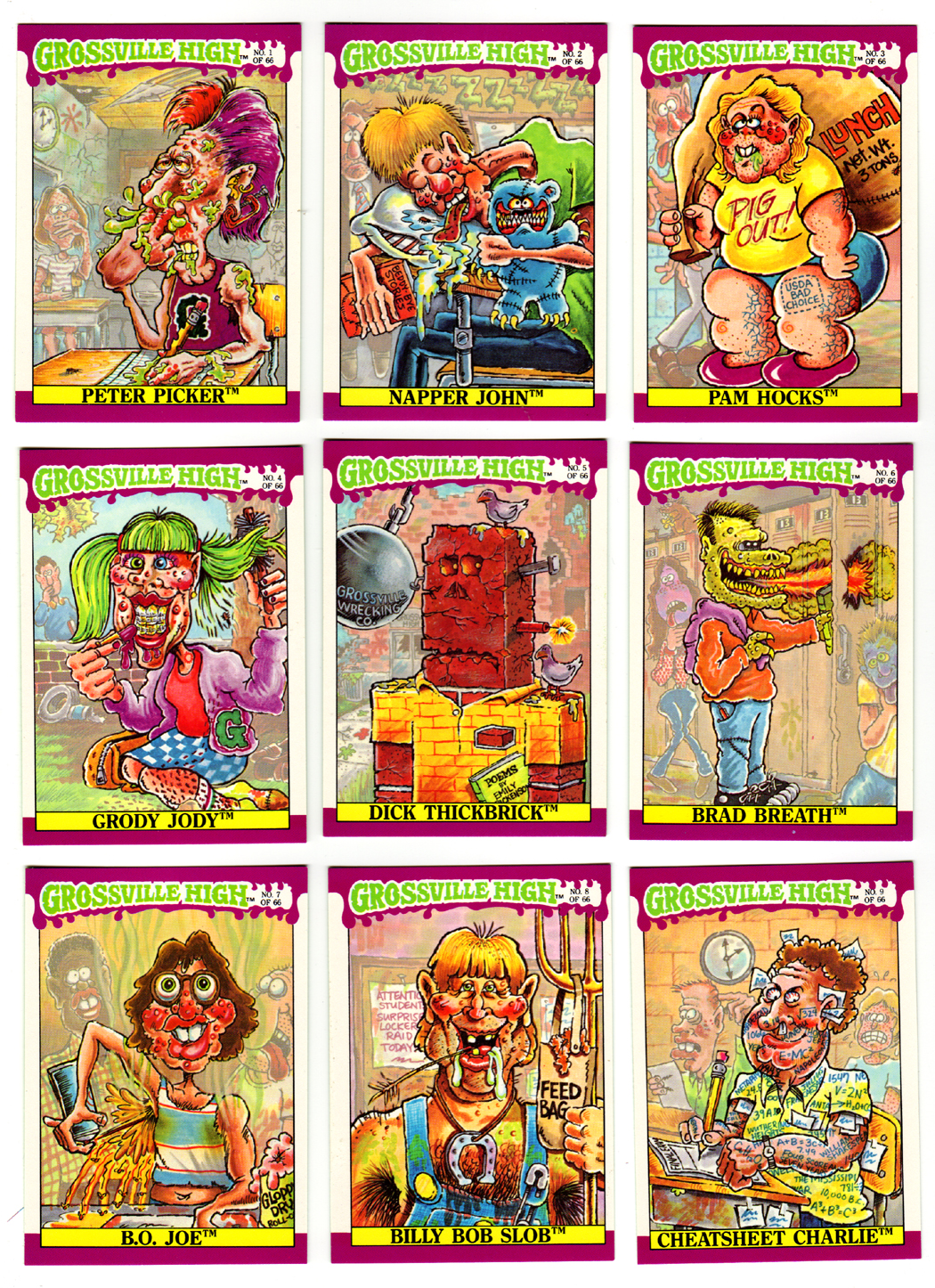
Tommy was in a cloud of confusion at school. He was distracted by the other students in class and their strange behaviors. Other kids talked about He-man cartoons, The Transformers, and brought lunch boxes depicting video game figures and containing candy, cookies, and coke products. He remembers girls were into Cabbage Patch Dolls and boys liked the Garbage Pail Kid cards. Tommy’s parents did not have a television or video game system, and did not let him eat candy or drink soda. They also thought the Garbage Pail Kid cards were too grotesque. So, Tommy sat through the day observing all the odd behavior, not realizing that a kind and patient teacher was trying to impart knowledge that would serve him well.

It was decided that Tommy would have to spend part of the day in a Reading Improvement Program (RIP), where he would be placed in a special classroom, a portable, and sit alone with a book and a tape-recorder which would read the book to him. And so, he spent his days at a carrel desk designed to keep him focused. He still remembers the first book he read with the program. It was John Henry the Steel Driving Man. It was far more entertaining than his regular classroom activities. He had heard the Johnny Cash version that his father sometimes played, but reading it, it made a lot more sense than the song to his young mind.

The book had a great impact on Tommy in several ways. He realized that he could read and what reading would mean to him from then on. The story was about a man who would not quit, despite great odds against him and despite many distractions—even if it killed him. After third-grade and his new found skill, Tommy became a voracious reader. In fourth grade he vastly out-read all the other students in the class combined, and won a top reader award. He remembers that, in fourth, fifth and sixth grades he was especially fond of mystery stories, including The Three Investigators, The Hardy Boys, Nancy Drew, and Encyclopedia Brown. In fifth grade Tommy started writing his own mystery stories and the teacher often had him read the stories in front of the class.

Reading that first book may well have laid the ground work for who Thomas would later become. Although he suffered a slight stigma in third grade for being in a RIP class (for dumb kids) and was teased for it, the lesson of John Henry the Steel Driving Man helped him overcome this and many more obstacles in life. When the kids made fun of him in third grade, he inwardly smiled because he was having a much more fun time in RIP than they were having in class.

Saturday, January 23, 2010

Spelling Bee Given by Illiterate Screwel Employee


It was lunch period at Von Toilet Bowl Tommy’s nickname for his favorite school in the seventh grade. A small group of thugs encircled him on the playground. One of the bullies shoved him and yelled, “Wanna fight $#!+head?”

Tommy’s backpack fell off his shoulder from the push. His marine father would not have taken this treatment from anyone. An adult playground monitor stood nearby, vigilantly monitoring, but doing nothing to help.

“You’re going to die,” the bully shouted as he shoved again. “I’ll shove that violin you play up your @$!”

The other thugs chuckled at Tommy’s torment.

Tommy punched the bully in the left eye hard enough to knock him to the ground.

The monitor sprang to the rescue, while calling bravely on his walkie-talkie for backup. He and his brave backup dragged Tommy and the bully to the Dean’s office.

Tommy had thought his fighting days were over after moving to Von Toilet Bowl Junior High from the sixth grade center in the bad neighborhood the year before.

Not so.

Tommy sat in the dean’s reception area facing a wall that was one big window looking out into the hall. The bully stood in the hall taunting him with his middle finger and making evil faces. Why was Tommy in the dean’s office and the troublemaker apparently free out in the hall? The injustice made Tommy tear up.

The secretary noticed Tommy’s tears, “Need a hanky honey?”

“Why is he free out there while I’m still in here?” asked Tommy, sounding somewhat meeker than he had intended.

“Oh, he’s not out there. He’s in the other room.”

“I saw him through the glass out there. He just flipped me off and threatened me. I could read his lips.”

The secretary rolled her eyes and dialed Tommy’s parents for the inevitable meeting – the meeting that would precipitate punishment for violating the zero-tolerance fighting rule.

Tommy would later learn that the bully had an identical twin, which explained why the bully in the window did not have a black eye. For the following two weeks, the identical twins were not so identical.

The Dean could have suspended Tommy, as he did with the bully. Instead, he punished Tommy with “in-house” suspension for three days, so Tommy wouldn’t miss school and his grades would not suffer. Tommy spent his suspension in a room with bad kids, isolated from everyone. He even had to eat lunch there.

Tommy’s sense of justice was shattered. He cried in front of his parents and the dean. The school did not care whether he lived or died. Kids could knife him while the monitor watched and did nothing, but the moment he defended himself, he was in trouble.

The Dean seemed genuinely concerned, “May I give your son something to read?”

It was the poem “If” by Rudyard Kipling. It was the Dean’s way to show that he disagreed with the school district’s draconian policy. The poem would comfort Tommy when faced with injustice in the years to come.

If you can keep your head when all about you
Are losing theirs and blaming it on you;
If you can trust yourself when all men doubt you,
But make allowance for their doubting too;

If you can wait and not be tired by waiting,
Or, being lied about, don’t deal in lies,
Or, being hated, don’t give way to hating,
And yet don’t look too good, nor talk too wise;


Yours is the Earth and everything that’s in it,
And – which is more – you’ll be a Man my son!

The rest of the year, no bully bothered Tommy. The mark of courage he punched into the bully’s eye lasted long enough to get the point across that Tommy should be left alone.

During in-house suspension, the school hosted a school-wide spelling bee for students in honors English classes. The winners would compete with the winners of other schools in the county, and eventually the State. Tommy knew he was by no means the best speller in the school.

The in-house suspension monitor called him to her desk to administer the test for the spelling bee. None of the other suspended students there were honors students, so only Tommy would take the test. The monitor was to read a word, and then Tommy would write it down correctly. Then the monitor would take Tommy’s list to his teacher.

Frequently, she did not know how to pronounce the word she was to read, and showed the word to Tommy before he wrote it down.

“I not sure how this word sounds. What you think?”

Tommy looked at the word, “Oh, that’s mnemonic (nuh-mon-ik).”

“Ok, what about this word?”

Tommy looked at the list again, glancing up and down it quickly before stating, “Oh, that’s pneumonia (nuh-moan-e-uh).”

After completing the list of twenty words, Tommy went back to his carrel desk and smiled. He could have written them all correctly, but he purposefully misspelled a few. He did not want to be the spelling bee champion of the school only to lose against another school.

In spite of his efforts, it was a three-way tie. The three top scorers went to the principal’s office for another bee to select the final representative. The other two students were eighth-graders, a year older than Tommy. Tommy did not win. He remembers one of the words that the principal told him sounded like “lawn-jer-ay,” a word Tommy had never heard before, spelled l-i-n-g-e-r-i-e. Tommy could not believe it. Later, he found the word in a dictionary and learned it was French for women’s undergarments.

“I thought it was supposed to be an English spelling bee,” he later told his English teacher. She was surprised he had scored so high the first time but came in last the second.

“Besides,” he added, “I don’t know much about women’s underwear!”